film soundtrack composer, sound / installation artist, curator – An architect designs works that occupy spaces; I create sound sculptures that fit in the flow of time and perception
L’enchevêtrement, ou intrication quantique, est un phénomène d’union de deux particules en un seul et unique système au sein duquel les deux particules deviennent codépendantes quelle que soit la distance qui les sépare. Un tel état est dit « intriqué » car il existe des corrélations entre les propriétés physiques observées de ces particules distinctes. Le théorème de Bell montre que l’intrication donne lieu à des actions non locales entre les particules.
Ainsi, si par exemple deux particules O1 et O2 sont enchevêtrées, cela ne signifie pas que les deux particules ne sont pas indépendantes, même si elles sont séparées par une grande distance, et nous devons considérer {O1 + O2} comme un seul système.
J’ai créé deux albums, en les percevant comme des systèmes, au sein desquels ces albums (particules) dépendent les uns des autres, quelle que soit la distance qui les sépare. Du point de vue de mon projet, la distance ici sera exprimée par le temps. Les états et les corrélations physiques seront représentés par le fait qu’un premier album produit sera dépendant du second de sorte que les deux albums devront être écoutés simultanément, donc les deux albums seront considérés comme un seul système et faisant référence au principe de non-localité.
Programme 1. Instantaneous knowledge (18’18) Publié sur Erototox Decodings
2. Unified quantum state (18’18) Publié sur ROOM40
3. Instantaneous knowledge et Unified quantum state (18’18)
Rendez-vous dans la Satosphère le 21 janvier dès 18h pour le premier Meetup Fulldome de l’année!
Une soirée entièrement consacrée à la création immersive, avec une attention particulière sur la spatialisation sonore.
Au programme: Présentations des artistes (18h – 19h) Jam (sur inscription seulement) & réseautage (19h – 20h30)
Artistes et passionné·e·s d’immersion sont invité·e·s à découvrir les actualités du milieu, à échanger avec leurs pairs et à tester leurs projets directement dans le dôme. France Jobin, Zac Collelo, Maxime Gordon Bénédicte, Weilu Ge
Inter/sperse at Musica – 27.09.2025 Inter/sperse, is a concert is specifically composed for church acoustics.
MUTEK est l’un des plus importants festivals internationaux dédiés aux musiques innovantes. Depuis 2000, il se produit chaque année au mois d’août dans le Quartier des spectacles de Montréal.
Invité dans le cadre d’une « prospective Québec/Canada », MUTEK propose un véritable festival dans le festival en une soirée. À travers un programme ambient dans l’église Saint-Paul, haut-lieu des soirées contemplatives de Musica, sont présentés des artistes qui font aujourd’hui vibrer la scène canadienne.
— 20h30 Quatuor Bozzini + Sixtrum
En première partie, le quatuor à cordes Bozzini et l’ensemble à percussion Sixtrum, tous deux basés à Montréal, proposent un programme court autour de Folk noir/Canadiana (2018) de Nicole Lizée, une œuvre qui incarne un des aspects de la culture musicale contemporaine canadienne : le dialogue entre différents registres musicaux, qu’ils soient populaires, expérimentaux ou contemporains.
— 21h15 Kara-Lis Coverdale
Pianiste, organiste et compositrice, Kara-Lis Coverdale est une des sensations de la scène minimaliste et expérimentale au Canada. Tout en évoluant comme organiste et cheffe de chœur dans différentes paroisses canadiennes depuis l’âge de 13 ans, elle a développé une trajectoire artistique singulière et une identité musicale contemplative, spectrale et organique. Après Kali Malone, Ellen Arkbro, Sarah Davachi et Claire Singer, elle complète la cartographie des « divas de l’orgue » dressée à travers la programmation de Musica au cours des dernières éditions.
— 22h15 Guillaume Coutu Dumont & Line Katcho
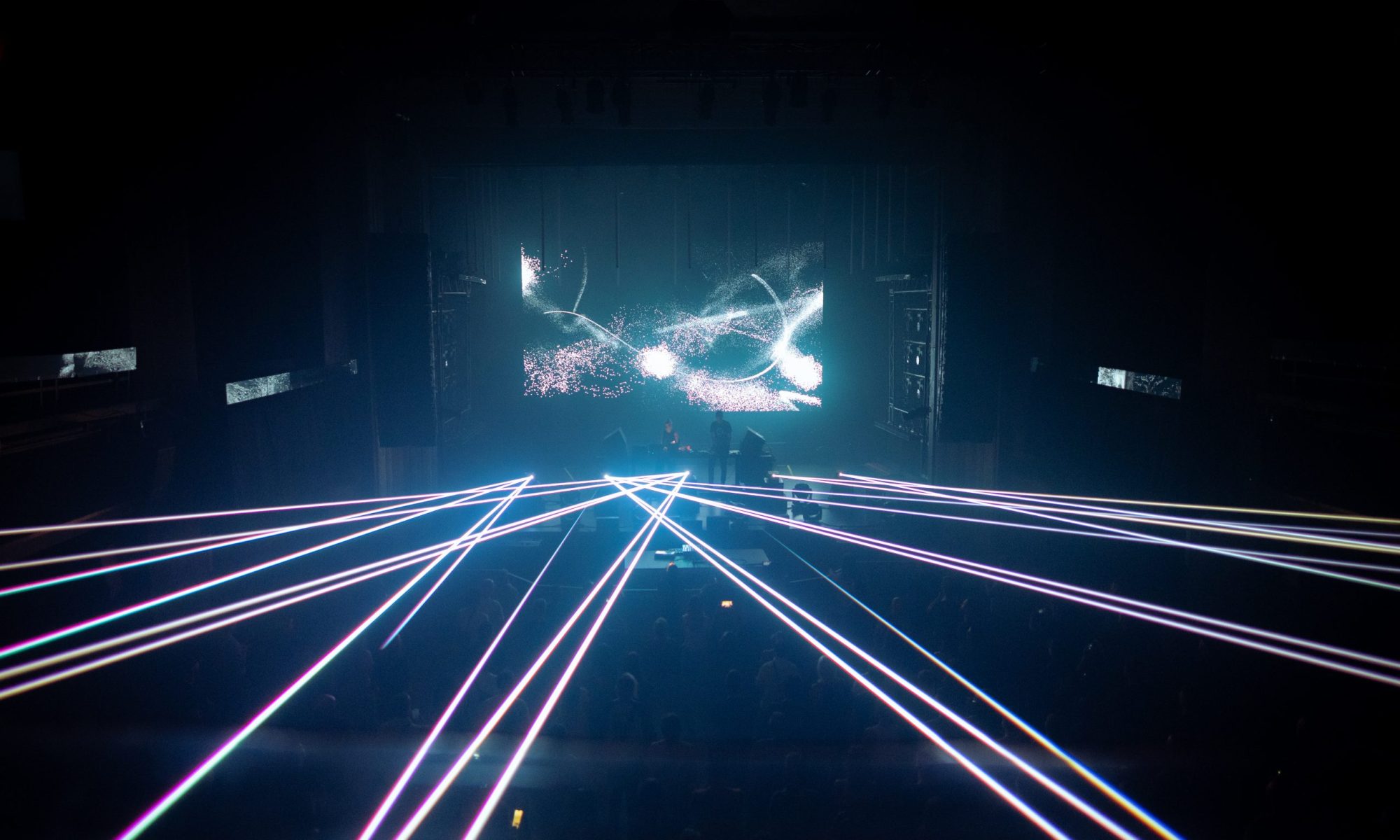
Guillaume Coutu Dumont et Line Katcho s’unissent pour créer une expérience immersive où la musique électronique rencontre l’art visuel. Guillaume Coutu Dumont, compositeur et musicien montréalais, apporte sa maîtrise des rythmes organiques et des textures électroniques, tandis que Line Katcho, artiste audiovisuelle, enrichit cette collaboration avec des paysages visuels enveloppants et une approche expérimentale du son. Ensemble, ils explorent les frontières entre le sonore et le visuel.
— 23h France Jobin
Artiste sonore, compositrice et curatrice basée à Montréal, France Jobin développe une pratique singulière à la croisée de l’art sonore et de la recherche électroacoustique. S’inscrivant dans une esthétique minimaliste, son travail est souvent qualifié de « sculpture sonore ». Elle explore avec finesse les interactions entre sons analogiques et numériques, donnant naissance à des paysages auditifs subtils et profonds. Ses installations immersives, à la fois musicales et visuelles, dialoguent étroitement avec l’architecture des lieux investis, invitant le public à une expérience d’écoute attentive et sensorielle.
The aim of the residency was to explore a variety of artistic approaches to quantum science and technologes. To this end, the project acknowledges the specificities and limits of both artistic and scientific practices, as well as their differences. To avoid the reciprocal instrumentalization of art and science – a risk faced by all arts-science initiatives – the project’s approach has been to encourage resonances between the two fields. Echoing the principle of constructive interference – where aligned waves amplify each other – this project explores how resonances between art and science can create more intense experiences and reveal new dimensions of understanding.
Primarily funded by the Dialogues quantiques research project, this artistic project enabled three female composers – Erin Gee, France Jobin and Jessica Moss – to immerse themselves in the IQ research environment, meeting and exchanging with a range of researchers over the course of four micro-residencies in 2024 and 2025. Each of the three composers approaches the resonances between art and science through her own perspective and sensibility, each developing a specific way of integrating the discoveries made during this process into her own musical practice.
From the outset of the project, the curatorial approach, led by Pia Baltazar, has drawn on the queer epistemology of quantum physics proposed by Professor Barad. In particular, Barad argues that quantum physics has provoked a profound questioning of the founding principles of classical representation – rooted in Euclidean geometry and Newtonian mechanics – not only in the field of physics, but also in our understanding of the workings of knowledge and the very nature of the fabric of reality. In their view, this dealt a fatal blow to the idea that classical forms of representation could be adequate to convey the specific understanding of time, space and matter introduced by quantum physics. This project takes this observation as its starting point and draws the consequences by focusing on the way in which music entangles time, space and matter in its own mysterious logic, proposing a medium as fluid and elusive as the quantum world it seeks to echo.
This intertwining of matter and space will be particularly explored using through sound immersion techniques and methodologies: drawing on the Scénophonie research project, led in collaboration between the SAT and Sporobole, and in relation to Sporobole’s points d’ouïe project, as part of which this evening will be presented. Here, the three composers will offer the audience a chance to hear the current state of their research and creative processes, whose final presentation is planned at the SAT in autumn 2026, within the production Structures of Nothingness.
In Teleport, Erin Gee uses biofeedback technologies to transform physiological signals (heart rate, respiration, skin conductance) in real time into electronic sounds inspired by quantum technologies and Qubits. Drawing on quantum teleportation and the ideas of physicist Elizabeth Rauscher, she conceives of emotion as quantum data transmissible through sound frequencies and states of full awareness. Her voice guides listeners through psychological superimpositions, mobilizing techniques derived from ASMR, hypnosis and placebo. Through sound and light, she induces altered states of sensitivity and attention. Teleport thus explores the intersections between the human body, affective computing and digital media, placing emotion in a perspective derived from quantum logic.
The fluctuation of emptiness is a sound art performance by France Jobin, that explores the principles of quantum computing through auditory expression. By interpreting the behavior of electrons and their quantum states, the performance translates the abstract workings of quantum algorithms into an immersive and evolving soundscape. Key elements such as stable electron pairs – Cooper pairs – BCS (soundscape), quantum errors (modular analog synthesis) and the fluctuations of emptiness are woven into the performance, enhanced by spatialization techniques inspired by “multiplexing Qbit addressing”.
Jessica Moss will be presenting new music from her upcoming album, titled Unfolding. Within the scope of her Sporo/SAT/IQ research, she’s been exploring the concept of coherence: in human experience a harmonious, unified state that transcends individual elements; in quantum physics the synchronized state of quantum particles, where their wavefunctions align in such a way that they work together harmoniously.
Moss has observed over time as a touring musician that there are certain musical elements that seem to consistently resonate with a very deep emotional expression from audiences. This has led her to explore, on both an artistic and political level, the power (and with it the responsibility) the performer may hold when consciously creating such an experience; one that aims to transcends individuality into a collective state. This performance at Sporobole will be her first foray into using spatialized sound as a conduit for this experience.
CURATION AND ART-SCIENCE COORDINATION
Pia Baltazar is an intermedia composer, indisciplinary researcher and directress of arts-sciences development at the Société des Arts Technologiques de Montréal (Québec, Canada). With a triple background in engineering, art philosophy and musical composition, her artistic and technological research has been developing for over twenty years at the intersection of interactive design and artistic production. She is particularly interested in the creative possibilities of the encounters between the senses (vision, hearing, touch…) and the involvement of the body and gesture in the creative process.
In her role as Directress of Arts & Science Development at SAT, she is responsible for developing innovative collaborations and partnerships with local and international artistic and academic communities. In particular, she seeks to develop arts-science projects and set up research-creation processes in artistic practice environments.
presented by Institut en sciences et génie quantique de l’ÉTS
Presented by Institut en sciences et génie quantique de l’ÉTS, Towards a Quantum Musical Aesthetic moderated by Pía Baltazar [SAT] invites composer and sound artist France Jobin, artist and physicist Sebastián Duque Mesa, and teaching professor Olivier Cardinal-Landon (ÉTS) to explore how principles of quantum mechanics—for example interference, entanglement, uncertainty—can inspire and transform music as both a conceptual and technological practice. As quantum computing advances, artists and researchers are questioning how music composition, performance, and listening might evolve in response to the advent of new technological devices and creative methodologies.
In addition to using quantum concepts from a creative standpoint, this panel considers how quantum thinking might reshape music structurally and experientially. Can music exist in multiple potential states until it is perceived? Can quantum randomness offer new generative strategies beyond classical algorithms? And how might quantum mechanical principles redefine the relationship between composer, performer, and audience?
This conversation spans metaphorical, technical, and philosophical dimensions—from algorithmic composition and granular synthesis to speculative listening practices that treat perception as a participatory act of world-building. Drawing parallels to the history of musical automatons and AI, the discussion extends to emerging quantum technologies as creative tools and provocations. Ultimately, the panel invites reflection on whether a shift in physics and technology demands a corresponding shift in our musical imagination—toward an aesthetic that embraces uncertainty, emergence, and the co-creative nature of reality.
Please note: this activity will be in English, with live transcription available.